In this article
- Bound the assessment to one application
- Establish evidence and critical unknowns
- Name the options that were considered
- Review the deliverables: a decision record and its recommendation
- Assess the recommendation and its limits
- Application modernization assessment checklist
- Find the next decision for your application
A sound application modernization assessment produces a written record that supports one decision about one application. The record shows what was inspected and what could not be accessed. It lists the routes considered, meaning the ways to deal with the problem, including leaving the application as it is for now. It names the open questions that would change the route. It ends with a conditional recommendation, the owner who decides and the next check: the observation that would answer the key open question.
Bound the assessment to one application
A legacy application assessment in this guide goes deep on one application and one blocker: the component or platform step that stops the next move. AWS separates portfolio-level and application-level assessment by the breadth and depth of information each needs. Microsoft expects an estate-wide assessment to produce a complete inventory and a business plan with cost analysis.
| Level | What it covers | Decision it supports |
|---|---|---|
| Portfolio | Estate inventory, business plan, cost analysis | Which applications to modernize first |
| One application | One blocker: components, build, environment, workflow | What to do about the blocker |
Gather what the assessor needs to inspect
The record first names what the assessor will inspect: the component and build in use, its environment and the business workflow that depends on it. It also names the accessible artifacts, their owners and the reason for change. Microsoft's Cloud Adoption Framework (CAF) likewise asks a proposal to name the affected workload and why modernization is on the table. Anything missing stays recorded as missing.
Establish evidence and critical unknowns
Evidence is a finding that another engineer can check: it names the artifact inspected, how it was observed and what it assumes. Findings written this way form a reproducible system description, which also lists what was not accessible and what each tool result rests on. The term is an analogy with NIST SP 800-30, a risk assessment guide that defines reproducibility as "The ability of different experts to produce the same results from the same data". Here it covers findings only.
An open question is a critical unknown when different answers lead to different routes. Critical here means that effect on the decision, separate from any severity label in a tool report.
Compare two entries about one observation:
| Needs its author to explain it | Anyone with the same access can check it |
|---|---|
| The library is flagged. | The manifest declares the library by name and version. A scanner flagged that version. Production was not inspected for lack of access. |
Distinguish a tool report from an assessment
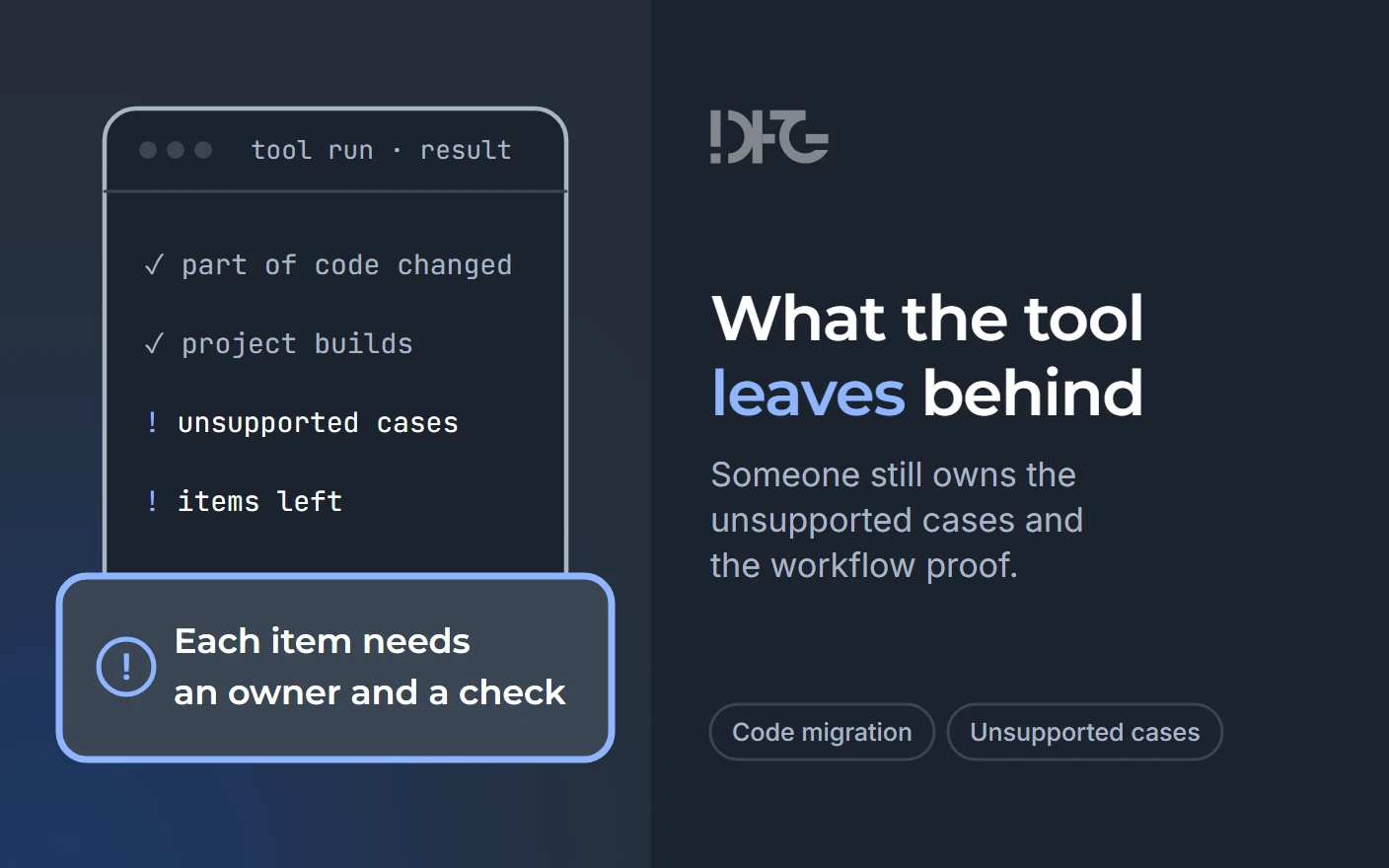
A tool report is evidence: it answers the question its target and rules set. An assessment record with a recommendation is a proposal, and a named owner accepts or rejects it. CAF divides the roles this way: workload teams recommend how to modernize, and business decision makers own the investment decision.
Vendor documentation shows what one report can settle:
- Microsoft's AppCAT for Java evaluates readiness for one target: replatforming and migration to Azure.
- IBM's AMA tutorial marks some report findings for review during testing. IBM's AMA Developer Tools walk developers through code changes needing their judgment.
- Red Hat backports security fixes into the packages it ships, so their version numbers alone do not show whether they are vulnerable. Some scanners that judge by version alone report false positives.
As of 2026-11-19, Google Cloud documents a Pre-GA, AI-powered tool that automates the modernization assessment of an application.
Name the options that were considered
The record compares routes, starting with support and the environment. CAF states the principle: "Modernization should make the least amount of change needed to achieve the required outcome".
| Route | Evidence for | Evidence against |
|---|---|---|
| Continue and reassess | Supplier support covers the library copy production loads | Which copy production loads is unconfirmed |
| Environment-only update | The vendor documents compatibility | Compatibility can break in practice |
| A change limited to the affected component | The blocker sits in one replaceable component | No compatible replacement confirmed yet |
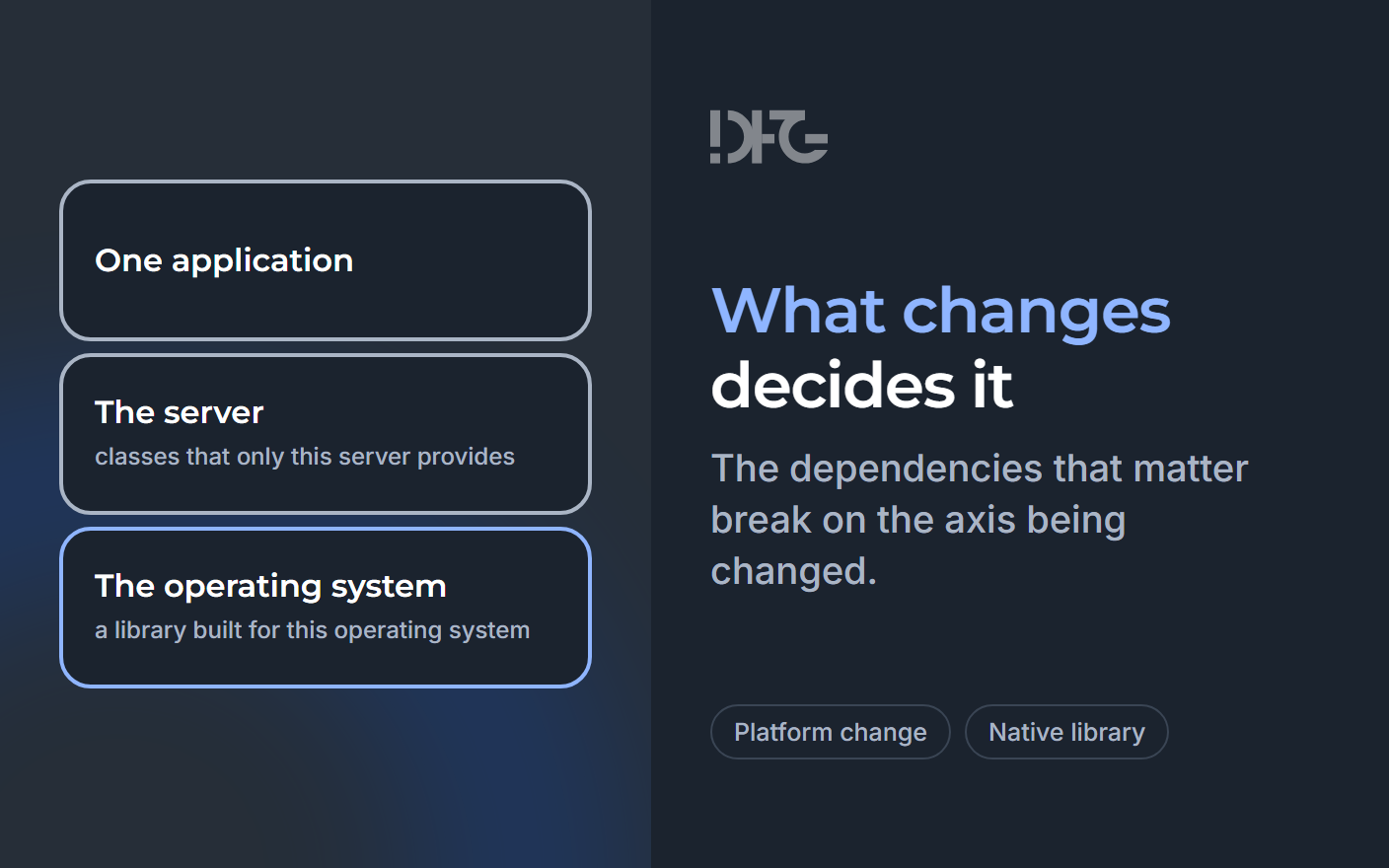
Continue and reassess keeps the application as it is under current support until a named condition reopens the decision. CAF uses it when the expected benefit does not outweigh modernization cost, risk or disruption; AWS lets an organization keep an application and migrate it later. An environment-only update changes the operating system or runtime and leaves the code as it is. Microsoft warns, for .NET Framework specifically, that compatibility can break through changes that look minor.
Who does the work is a separate choice:
| Who does the work | Evidence for | Evidence against |
|---|---|---|
| Current team | The team can build and run the workflow | Missing access or platform knowledge |
| Tool-assisted work | The tool's rules match the target | Fixes need developer judgment |
Review the deliverables: a decision record and its recommendation
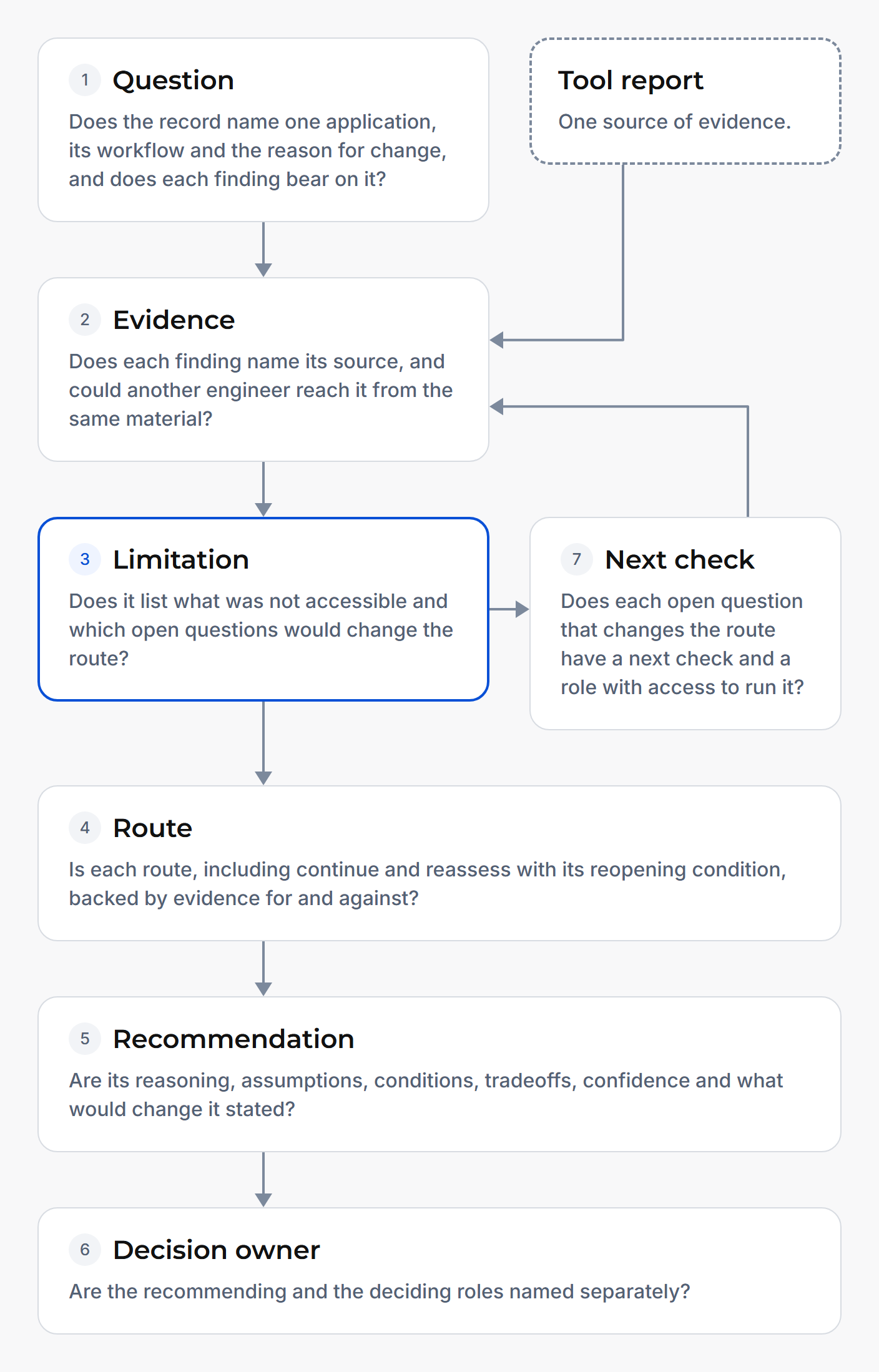
The main deliverable is the written record: one question about one application, answered in seven fields. Evidence includes the dependencies the blocker touches. A tool report is one source of evidence; the next check feeds new evidence back:
A feasibility recommendation names the route, the conditions under which it holds, its tradeoffs and what would change it, without cost or payback estimates. Azure Well-Architected guidance advises recording the confidence level of each decision.
Work through an illustrative findings record
Illustrative example: a fictional application and a fictional record.
| Field | Entry |
|---|---|
| Question | Does a third-party library block the platform step for an insurer's internal reporting application, and which route clears it with the least change? Trigger: a scanner flagged the library by version. |
| Evidence | Inspected: dependency manifest and build file, naming the library and version; calls to it in one reporting module; the scanner report, resting on the version number alone. |
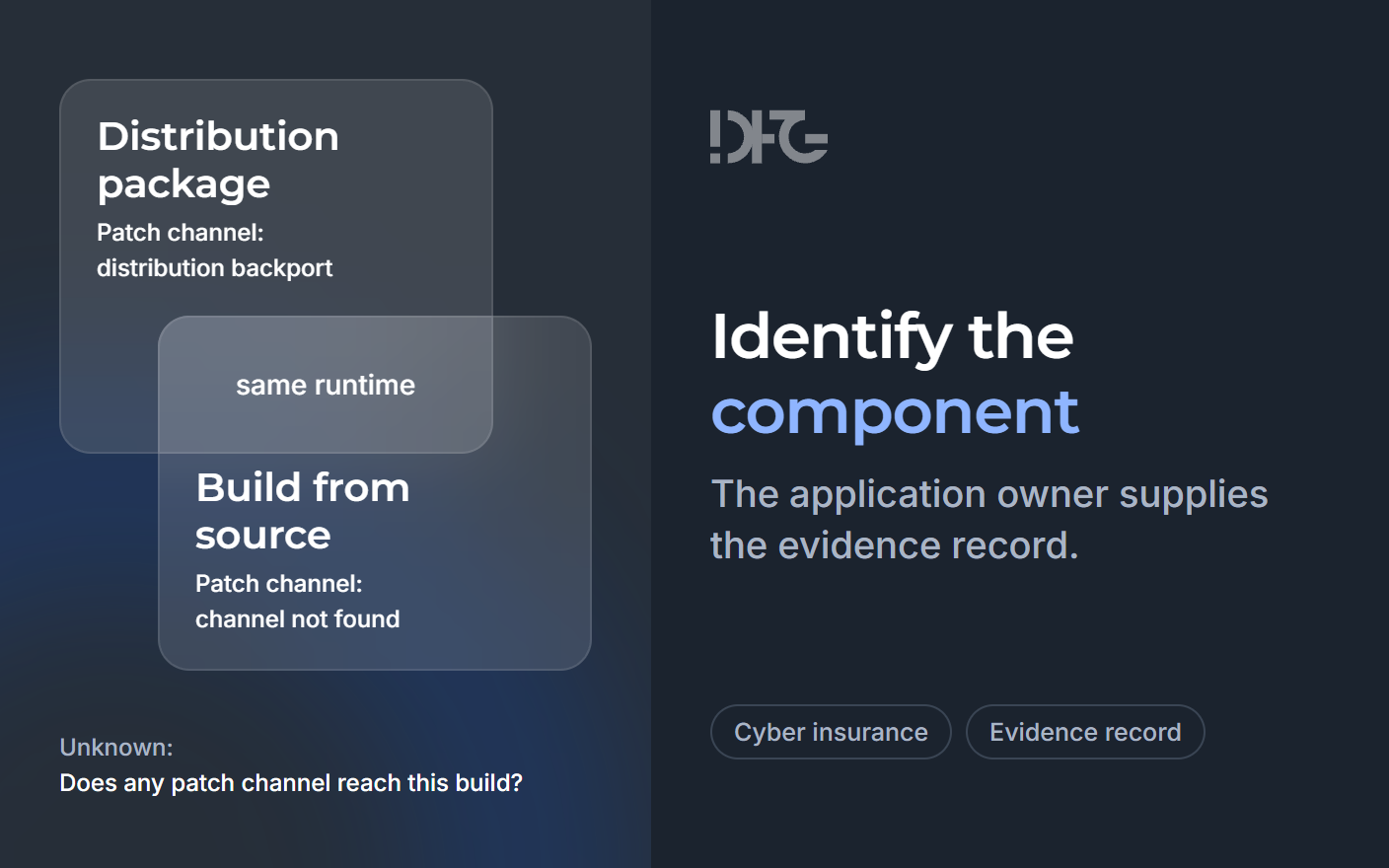
| Limitation | Not inspected, for lack of access: production. Open question that changes the route: does production load an operating system distribution package or a copy shipped inside the application? For a distribution package whose maintainer backports fixes, the version number does not show whether the fix is present. A copy inside the application has no distribution backport channel; this is an inference. |
| Route | Considered: continue and reassess, environment-only update, a change limited to the affected component; for a change, the current team or tool-assisted work. Whether a compatible version can replace the library without changing the reporting run matters only for a change; the recommended route stays the same. |
| Recommendation | Conditional. Distribution package whose maintainer backports fixes: continue and reassess, reopening when the platform step is scheduled or the copy production loads changes. Otherwise: move the library to a compatible version once the replacement is checked. Confidence: low until the next check. |
| Decision owner | The application team recommends; the business owner of the investment decides. |
| Next check | List each package's maintainer and the path of the library production loads: an observation by someone with production access. |
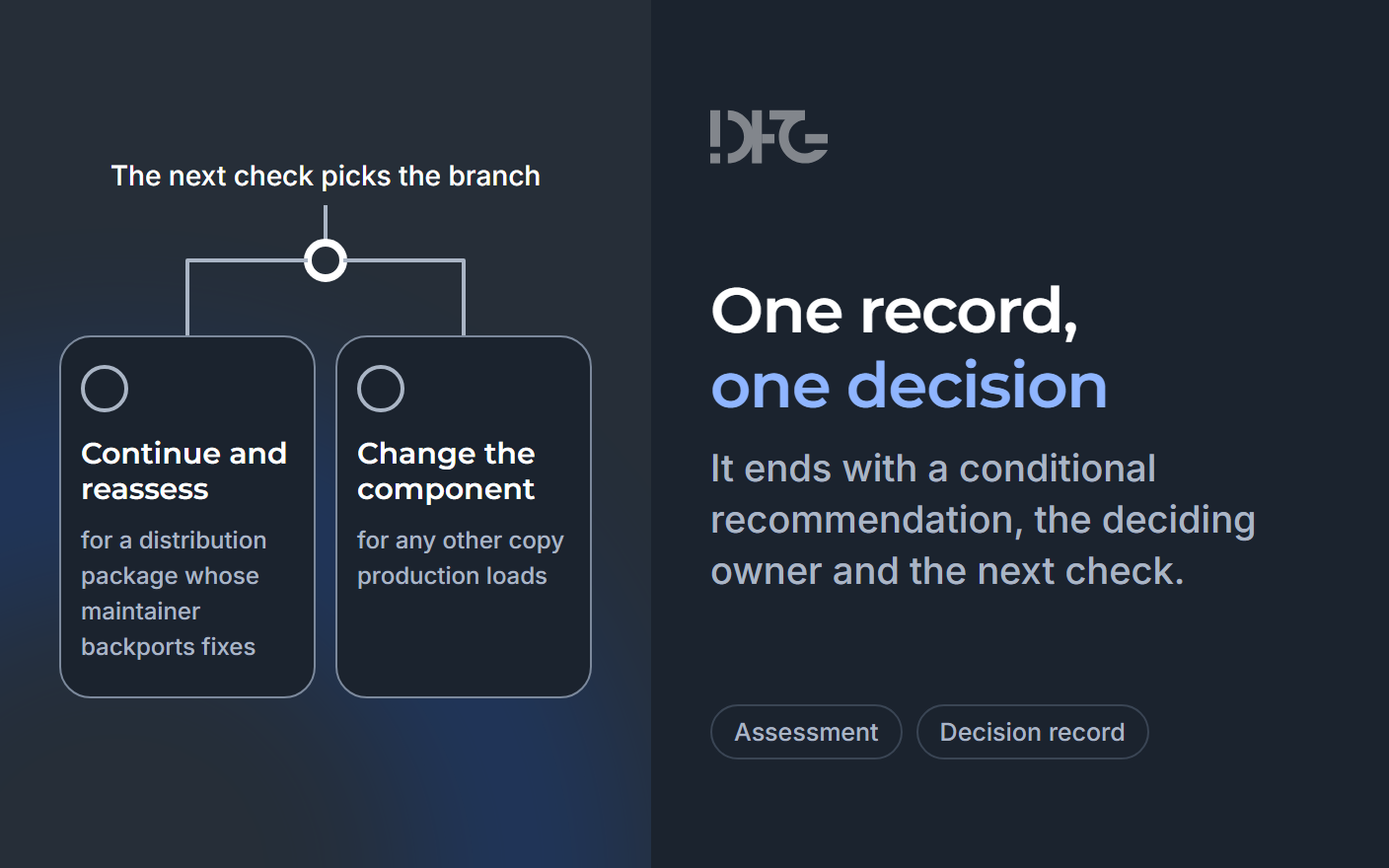
The next check picks the branch. A distribution package whose maintainer backports fixes leads to continue and reassess; any other copy, to a change limited to the affected component.
Limit of this method: the record holds only what the assessor could inspect.
Assess the recommendation and its limits
An owner tests a recommendation by tracing it to the evidence. Each step from finding to route should be written down. Each assumption should name the condition that ends it, such as a scheduled platform step. When that condition arrives, the decision reopens.
Where an assessment ends
An assessment describes the existing system and stops where a change would begin:
- Inside: inspecting artifacts, requesting information, comparing findings with vendor guidance.
- Outside: any trial change to code or configuration.
- An open question only a trial change can close becomes the next check, named and left unperformed.
- Checking a code change, release to production and a portfolio plan are separate decisions.
Application modernization assessment checklist
Use these questions on any assessment, yours or one you received.
- Question: does the record name one application, its workflow and the reason for change, and does each finding bear on it?
- Evidence: does each finding name its source, and could another engineer reach it from the same material?
- Limitation: does it list what was not accessible and which open questions would change the route?
- Route: is each route, including continue and reassess with its reopening condition, backed by evidence for and against?
- Recommendation: are its reasoning, assumptions, conditions, tradeoffs, confidence and what would change it stated?
- Decision owner: are the recommending and the deciding roles named separately?
- Next check: does each open question that changes the route have a next check and a role with access to run it?
Find the next decision for your application
The first unanswered question in the checklist points to the smallest open decision: an access request, a package list, a named owner or a reassessment condition.
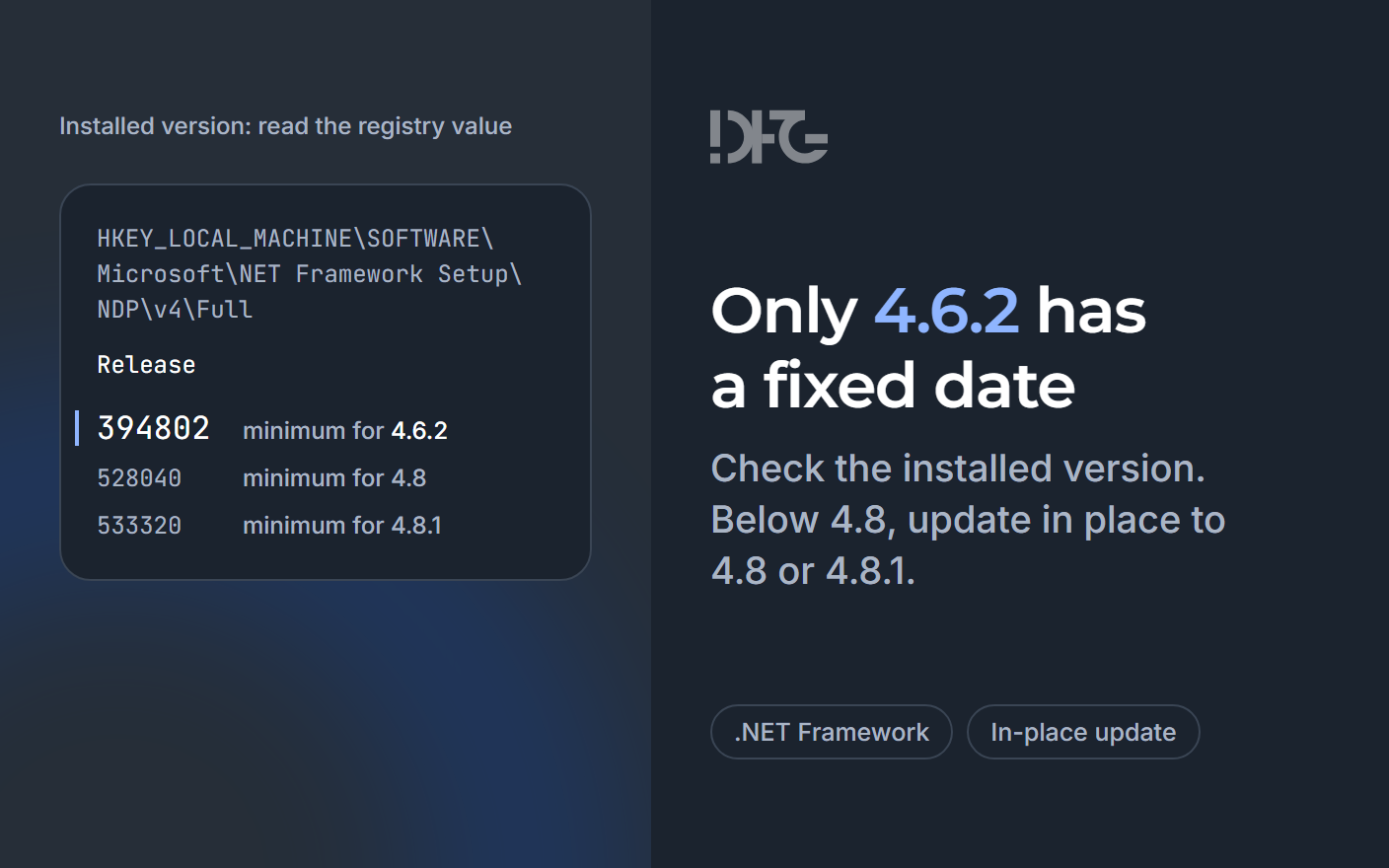
If the blocker is .NET Framework support, check .NET Framework version support: that article covers supported versions, this guide the decision record.
If one application is blocking a platform step, note the component, its version and the workflow that depends on it. Share them with DFG to discuss what to check first.
Describe the application that is blocking you
Sources
- AWS: Application portfolio assessment guide
- AWS: About the migration strategies
- Microsoft: Modernization preparation, marked AI-assisted
- Microsoft: Assess your application modernization needs
- Microsoft: AppCAT for Java
- Microsoft: Maintain an architecture decision record
- Microsoft: Version compatibility in .NET Framework
- IBM: Get started with AMA
- IBM: Get started with AMA Developer Tools
- Google Cloud: Create an App Modernization Assessment
- Red Hat: Backporting Security Fixes
- NIST: Glossary, reproducibility
- NIST: SP 800-30 Rev. 1
Frequently asked questions
What is an application modernization assessment?
A written record that supports one decision about one application. It shows what was inspected and what was not accessible, the routes considered, the open questions that change the route, a conditional recommendation, the deciding owner and the next check.
How is assessing one application different from assessing a portfolio?
AWS separates them by the breadth and depth of information each needs. A portfolio assessment inventories the estate to plan investment. An assessment of one application goes deep on one blocker: its components, environment, workflow and decision owners.
What counts as evidence in an assessment record?
A finding another engineer can check from the same material, with its artifact, method and assumptions. A tool report counts once its target and rules are recorded. For packages where Red Hat backports fixes, version numbers alone do not show vulnerability.
What should an assessment say about missing information?
It names what was not accessible and keeps those questions open, so missing evidence stays unknown. A question whose answers would lead to different routes gets a next check and a role with the access to run it.
What should a recommendation to continue and reassess record?
The evidence that current support is sufficient and the condition that reopens the decision, such as a scheduled platform step. Microsoft's CAF uses this outcome when the expected benefit does not outweigh modernization cost, risk or disruption.
Where does an assessment stop?
Before any change to the system. Inspecting artifacts, requesting information and comparing findings with vendor guidance are inside it. When only a trial change can close an open question, the assessment names that change as the next check.
Is an automated assessment report enough to approve application changes?
A report answers the question its target and rules set; a named owner decides. Microsoft's CAF keeps accountability for validating decisions in place, IBM describes code changes that need a developer's judgment, and Red Hat reports false positives from some version-only scanners.
What should an owner be able to verify before deciding the next step?
The source of each finding, what was not inspected, which routes were weighed, which open question changes the route and when the recommendation holds. The owner also sees who recommends, who decides and which check comes next.