In this article
When the business has decided to migrate off WebSphere traditional or AIX and one application will not move, start by naming the dependency that holds it. Then decide whether environment work removes it or the code must change.
The platform change is taken as given here, with no assumed end-of-support date and no cloud destination.
Name the application condition blocking the move
The condition that stops the move is the blocker: one named item in the application that holds back the platform change. A blocker record writes it down in five fields.
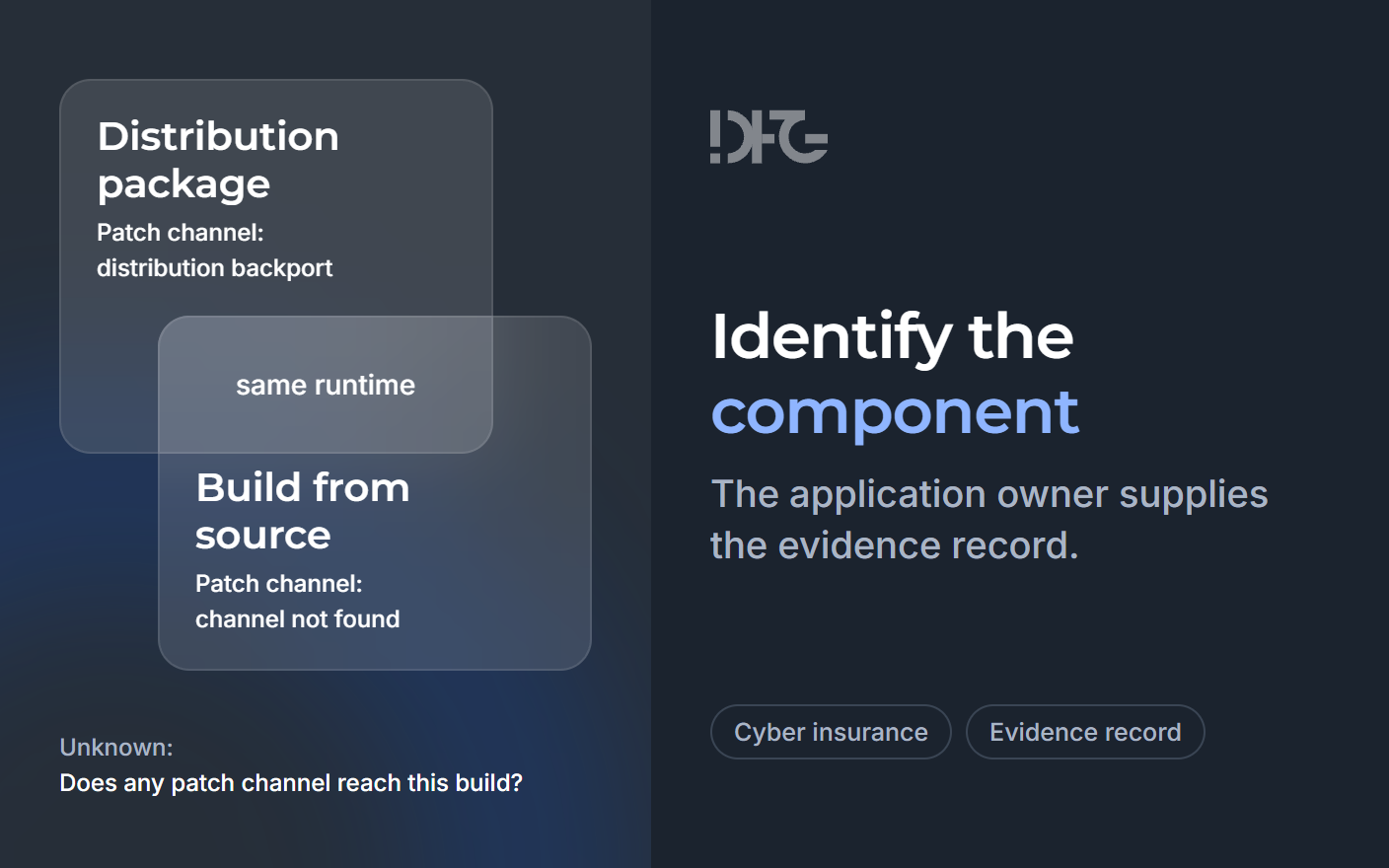
Illustrative: an internal reinsurance reporting application runs on WebSphere traditional 9.0.5 on AIX. Its report generator calls a native library through JNI, the standard way Java code calls C or C++ code. The library is built for AIX and sits as an .a file on the native library path.
| Field | Entry |
|---|---|
| API, library or configuration item | Native report library libreportgen.a, loaded through JNI by the report generator |
| Evidence | Checked: the file and the loading call. Not checked yet: whether source code exists. Vendor statement: IBM calls native libraries platform-specific. |
| Owner | Whoever holds the source code and compiler, or the library vendor |
| Target condition | Leave AIX for another operating system and keep WebSphere traditional at the same release |
| Workflow check | The monthly reinsurance report runs end to end on the target, and its binary data files read back correctly |
Checked means someone looked at the item or ran it. Not checked yet means nobody has looked. Vendor statement means the vendor documents it and nobody has tried it here. This native library dependency is an AIX application blocker only because the target condition leaves AIX.
Separate platform preference from lifecycle evidence
For current WebSphere releases, lifecycle evidence gives no date to plan against. IBM's support page states: "There is no planned end-of-support date for WebSphere 8.5.5 and 9.0.5." WebSphere traditional and Liberty, IBM's other Java application server, follow separate lifecycle policies. IBM states that Liberty's single code stream removes end-of-support announcements for it.
Support for one server depends on its fix pack level. A fix pack is IBM's update package. An iFix is an individual fix on top of it, available for any traditional fix pack up to two years from its release.
The Java runtime is a separate product with its own support terms, and on Liberty the customer keeps it on a supported Java SE. AIX support terms do not reduce to one date with traditional, Liberty or the Java runtime either. The platform change stays a business preference that these pages neither confirm nor overturn.
Inventory the dependencies that matter
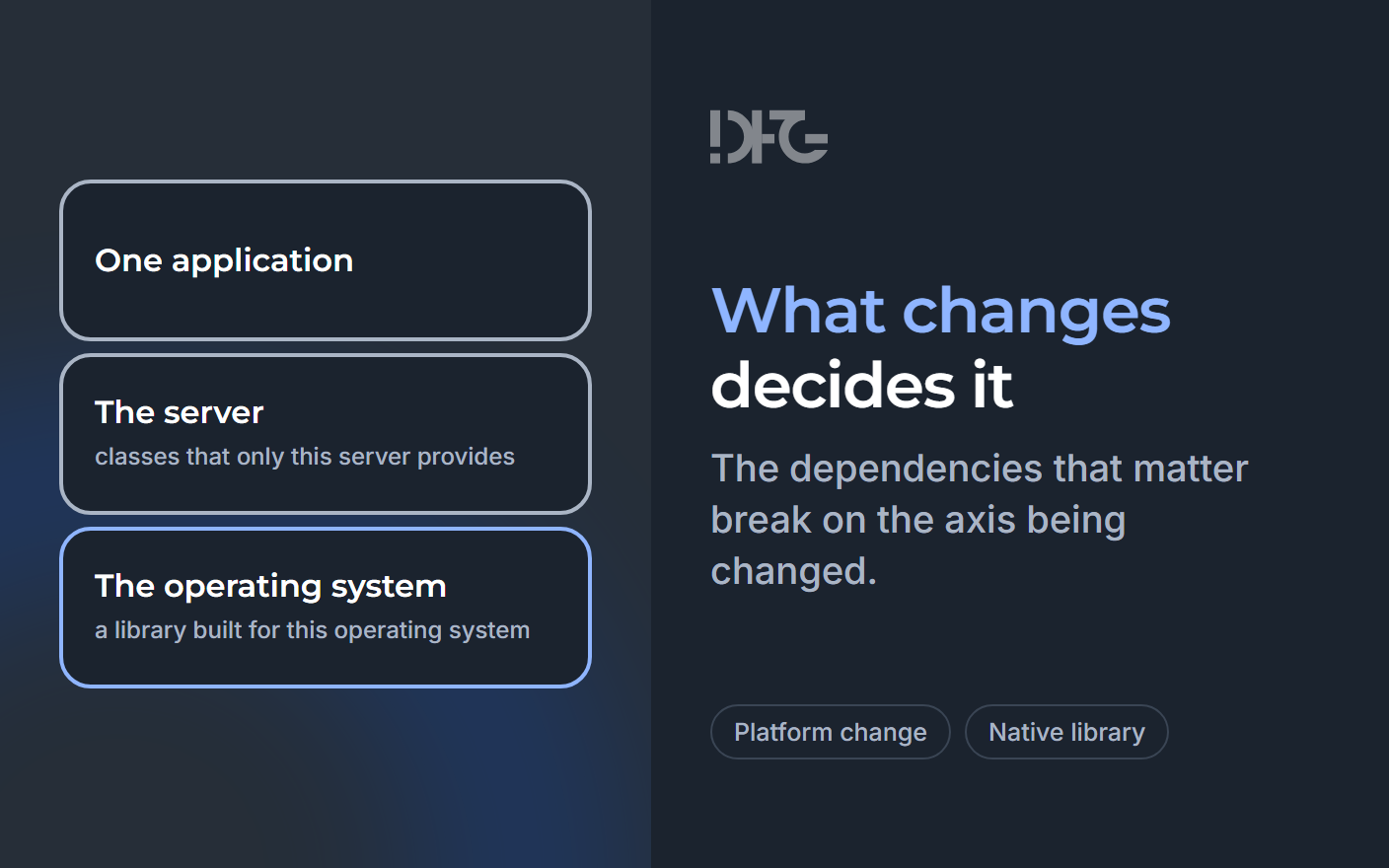
The dependencies that matter are the ones that break on the axis being changed. That axis is the server, from WebSphere traditional to Liberty, or the operating system, from AIX to another system under the same WebSphere traditional. Seven classes cover WebSphere application dependencies; where no vendor page settles a cell, it says what to check.
| Dependency class | When the server changes | When the operating system changes |
|---|---|---|
| Exact runtime and server edition, with fix pack level | The Liberty support policy applies, and the customer supplies a supported Java SE | IBM's migration commands move a 9.0 configuration profile to another 9.0 installation on another machine and operating system |
| Proprietary IBM APIs | Frequent cause of code change: IBM marks some WebSphere runtime classes unavailable on Liberty, class by class | The classes ship with the unchanged product; check the release on the target |
| Deployment configuration: JNDI names (lookup names for databases and queues), JVM options (start-up settings of the Java virtual machine) | Resources are redefined in the Liberty configuration; IBM JNDI values in code need a code change | Check paths outside the profile and JVM options by a run on the target |
| Security and identity | Liberty supports a subset of traditional security features, and each server has its own LTPA sign-on keys by default | Check sign-in, sign-out and roles on the target |
| Native libraries | No block while the server stays on AIX: IBM lists AIX among the supported operating systems for Liberty | The library is platform-specific, an .a file on AIX: rebuild or replace it |
| Admin and start scripts | Scripts for wsadmin, the Python scripting tool of traditional, need a new form: Liberty has no Python shell | Check paths, operating system commands and automatic start |
| External connections | Check each adapter; Liberty lacks J2C principal mapping modules, which map a user to connector credentials | Check addresses, drivers and client libraries on the target |
If the Java runtime also changes, check its JVM options by a run on the target.
Check proprietary APIs, native libraries and configuration
The register lists what was checked in the illustrative application, with status and owner, and names one blocker. Proprietary application APIs and configuration decide a server change; the native library decides the move off AIX.
| Dependency | Status of the check | Who owns it | Effect of leaving AIX |
|---|---|---|---|
| IBM JNDI values in a lookup helper class | Checked | Application team | Moves with the same server release |
| Native report library | Checked | Source holder or library vendor | The blocker: rebuild or replace |
| Data source and JVM options in the server profile | Vendor statement: the profile moves with IBM's migration commands | Middleware administrator | Paths and JVM options to check by a run on the target |
| Start script that sets the library path | Not checked yet | Operations team | Paths to check on the target |
Review toolkit findings and remaining unknowns
A migration tool reports a defined set of WebSphere issues, and the remaining unknowns stay with the application owner. In a WebSphere application migration assessment, IBM's Application Modernization Accelerator (AMA) scans the application server environment. It inventories artifacts, technology use, Java and Java EE API versions, shared libraries and infrastructure dependencies. IBM's tutorials show that AMA flags or prepares:
- WebSphere runtime classes and interfaces unavailable on Liberty;
- IBM JNDI values written into code, with an automated fix;
- code files common to several applications;
- external dependencies to verify during testing: messaging, databases, remote EJB providers and Java EE security;
- a starting Liberty server configuration with features, data sources and environment variables.
AMA Developer Tools fix some issues automatically. Others come as guided fixes with an explanation, the affected file and suggested code, which a developer applies.
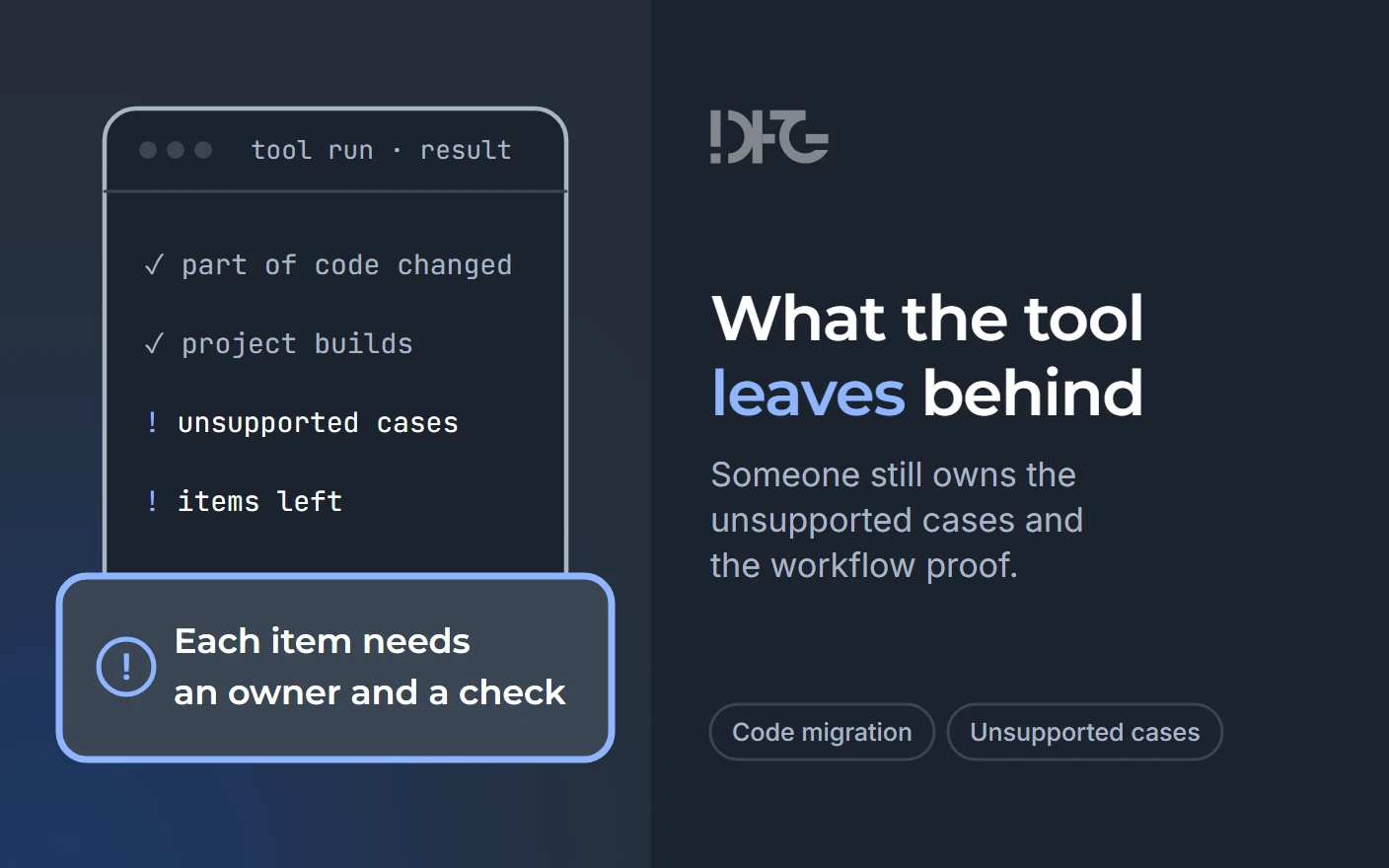
These rules are written for a move to Liberty. Native libraries, your own scripts and JVM options are checked directly: list them, then run the named workflow on the target.
Compare environment-only and code-required routes
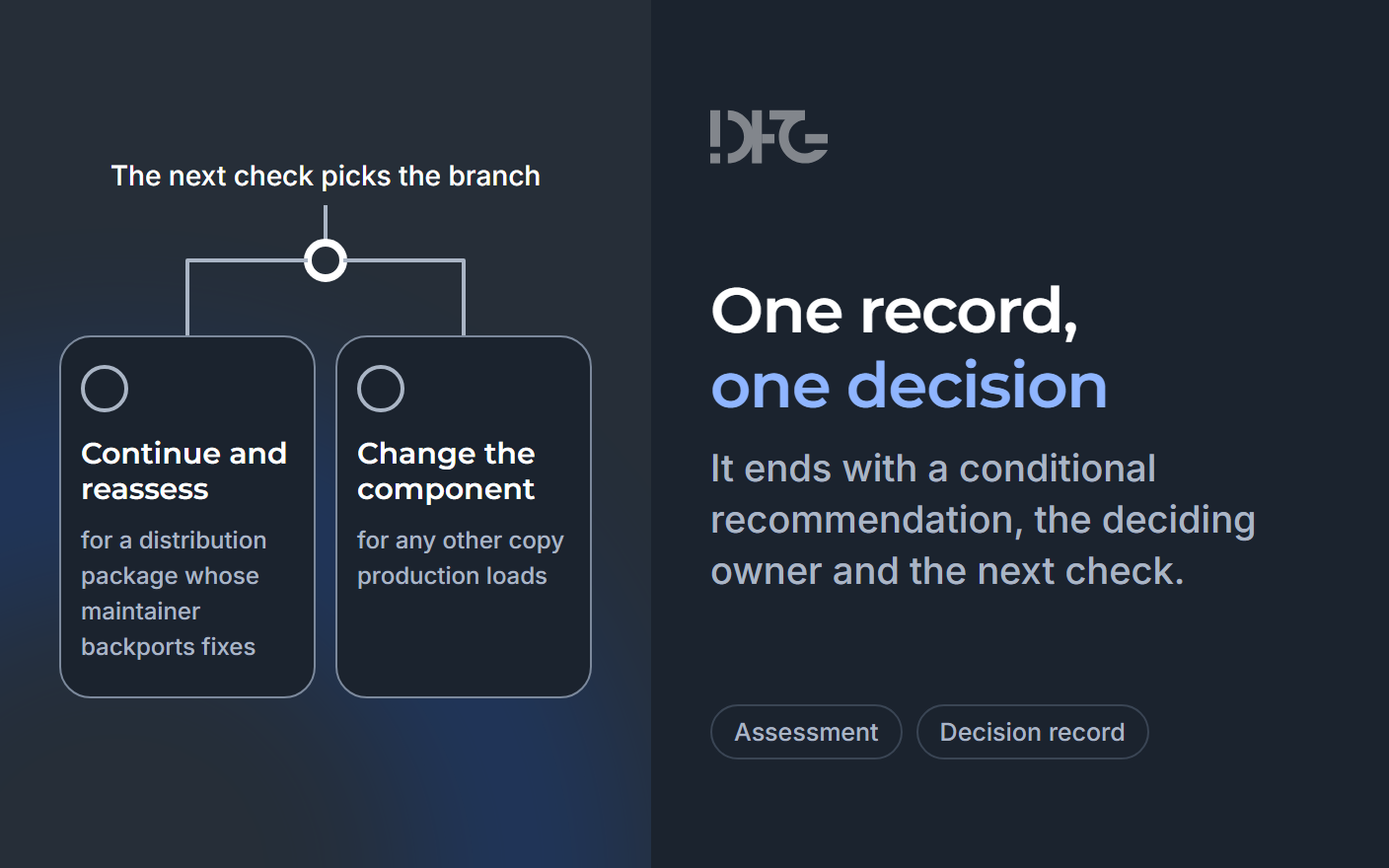
Routes are compared from the least work to the most. A route is a way to remove a blocker, and there are three. Current support keeps the application on its server, under IBM support on a current fix pack. Environment-only keeps the same code and changes the server or operating system, with its configuration, scripts and connections. Code-required changes a component's code, and that change is a bounded code change, limited to the component. Current support and other sufficient results come first, because the smallest acceptable result may avoid an application project.
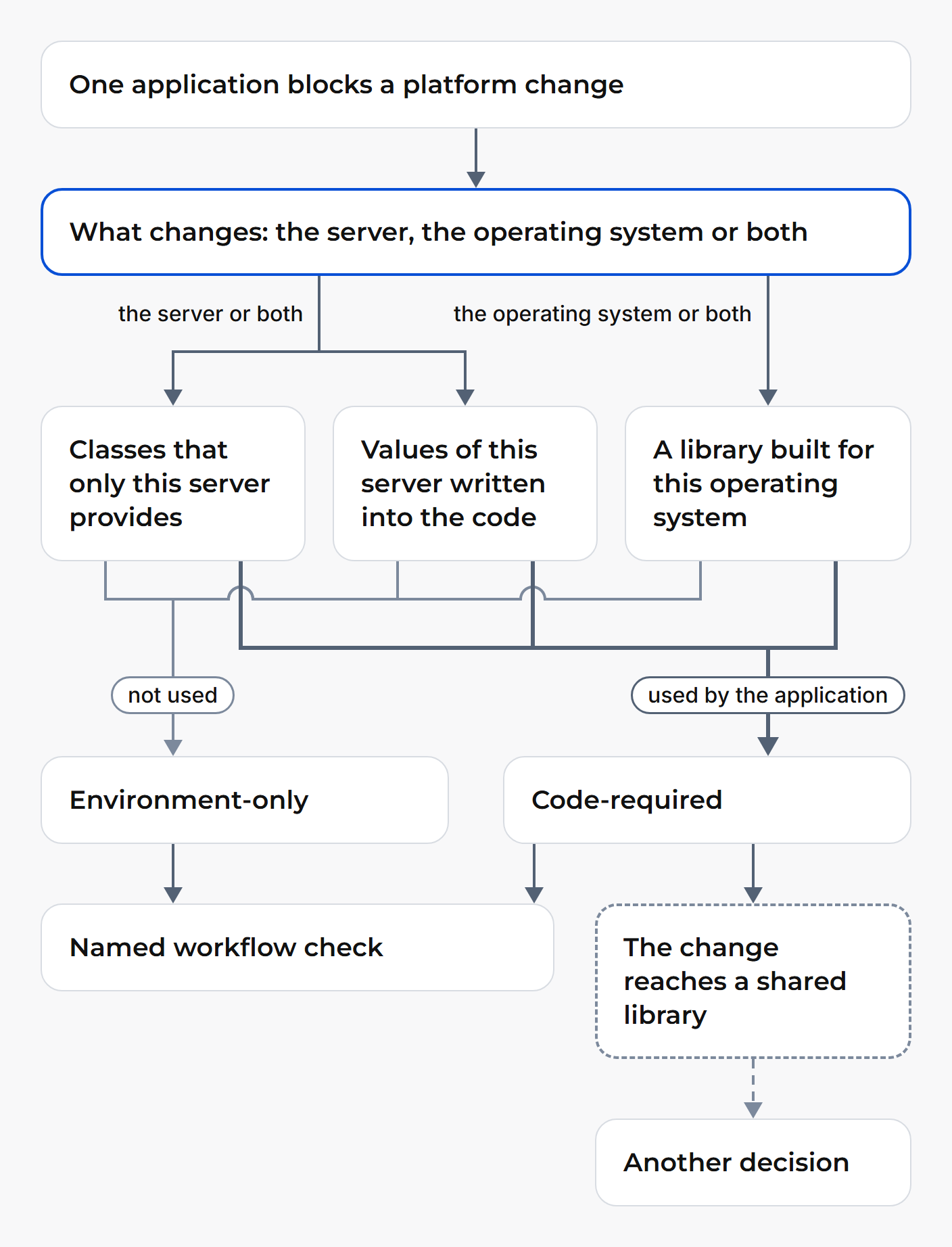
The first question is what changes: the server, the operating system or both. For the server or both, check classes that only this server provides and values of this server written into the code. For the operating system or both, check a library built for this operating system. An item used by the application leads to code-required; if it is not used, the route is environment-only. Both routes end in a named workflow check. When the change reaches a shared library, a dashed branch leads to another decision.
On Liberty on the same AIX, the illustrative library would not block: IBM lists AIX among the supported operating systems for Liberty. Its route would be environment-only. The record names a different target: leaving AIX. Built for AIX, the library will not load on another operating system, so it is rebuilt from source or replaced. The route is code-required. The bounded code change covers the rebuilt library and the code that loads it. The workflow check runs the monthly report and reads back its binary data files.
A route says what to do; the executor is who does it: the in-house team, the current contractor or DFG. When DFG is asked, we compare current support, environment-only and code-required first, and any of them can be the outcome.
Keep shared dependencies inside an explicit boundary
A shared dependency gets an explicit boundary: it stays outside the proof for one application. If the rebuilt library also serves a second reporting application, or stored report data needs converting, record another decision:
- Owner: the team of the second application, or the owner of the data.
- Unknown: whether that application calls the same library functions and reads the same files.
- Next check: a run of its own workflow against the rebuilt library.
Agree what one application proof must establish
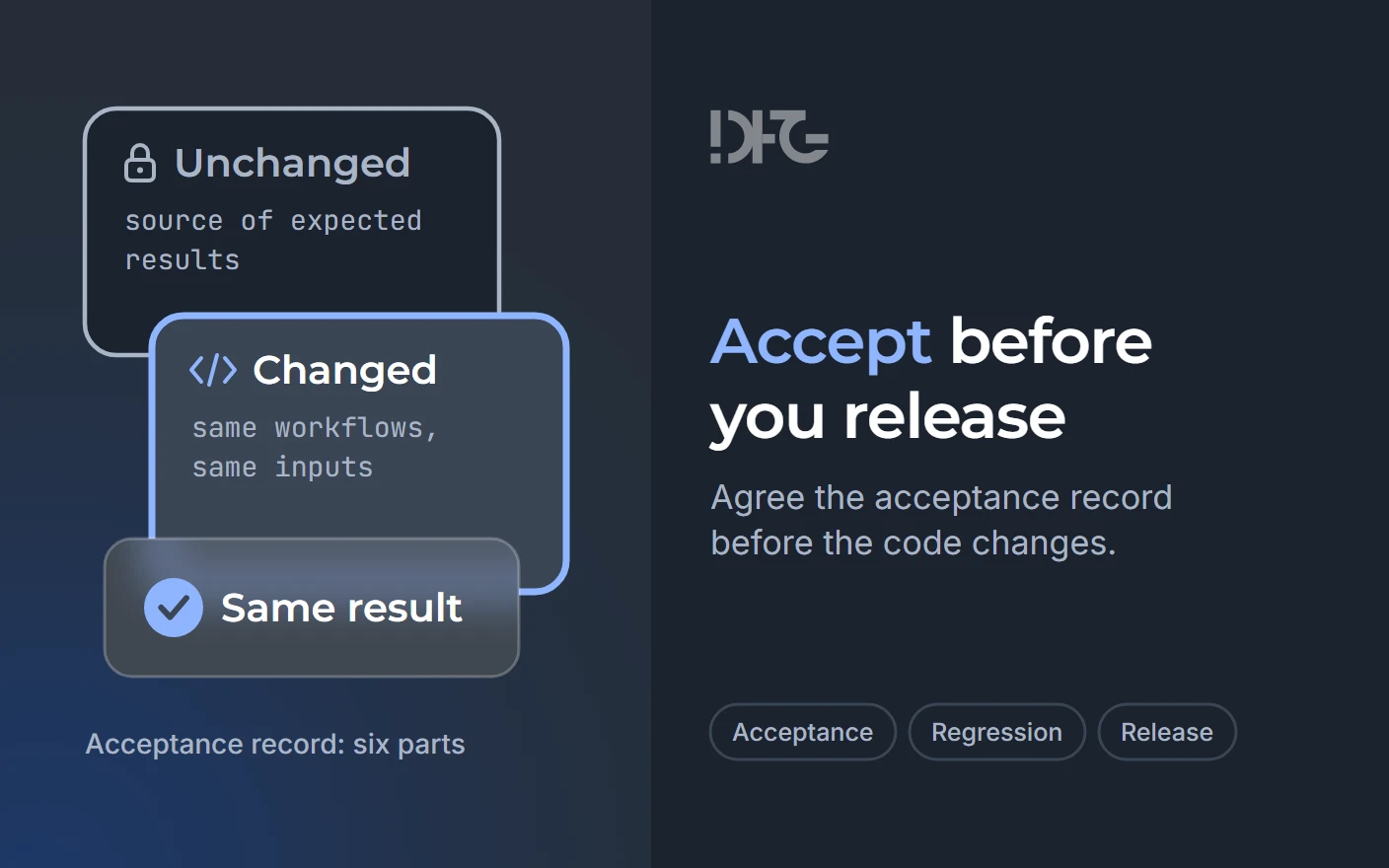
One application proof establishes that the bounded code change works under target conditions agreed with the owner before work starts. For the illustrative application, it covers:
- the changed component: the rebuilt library and the code that loads it;
- the target conditions: operating system, WebSphere traditional release and fix pack, Java runtime;
- build instructions that rebuild the library for the target;
- the named workflows: the monthly reinsurance report and its binary data files;
- the known differences from the run on AIX, each with its evidence status.
Keep production migration a separate decision
Accepting the change leaves the production migration as its own decision, with separate choices on:
- production security settings and keys;
- production scripts, schedules and connections;
- the release plan and the rollback path;
- any data that moves with the application.
Record the evidence, owner and remaining uncertainty
Recording the evidence, the owner and the remaining uncertainty lets a reviewer see what is known, who answers for it and what is still open. An item moves from not checked yet to checked only after someone looks at it or runs it. A vendor statement keeps its label until a run on the target confirms it. Known differences sit next to the evidence, each with the owner who accepts it.
Define the application blocker before choosing the route
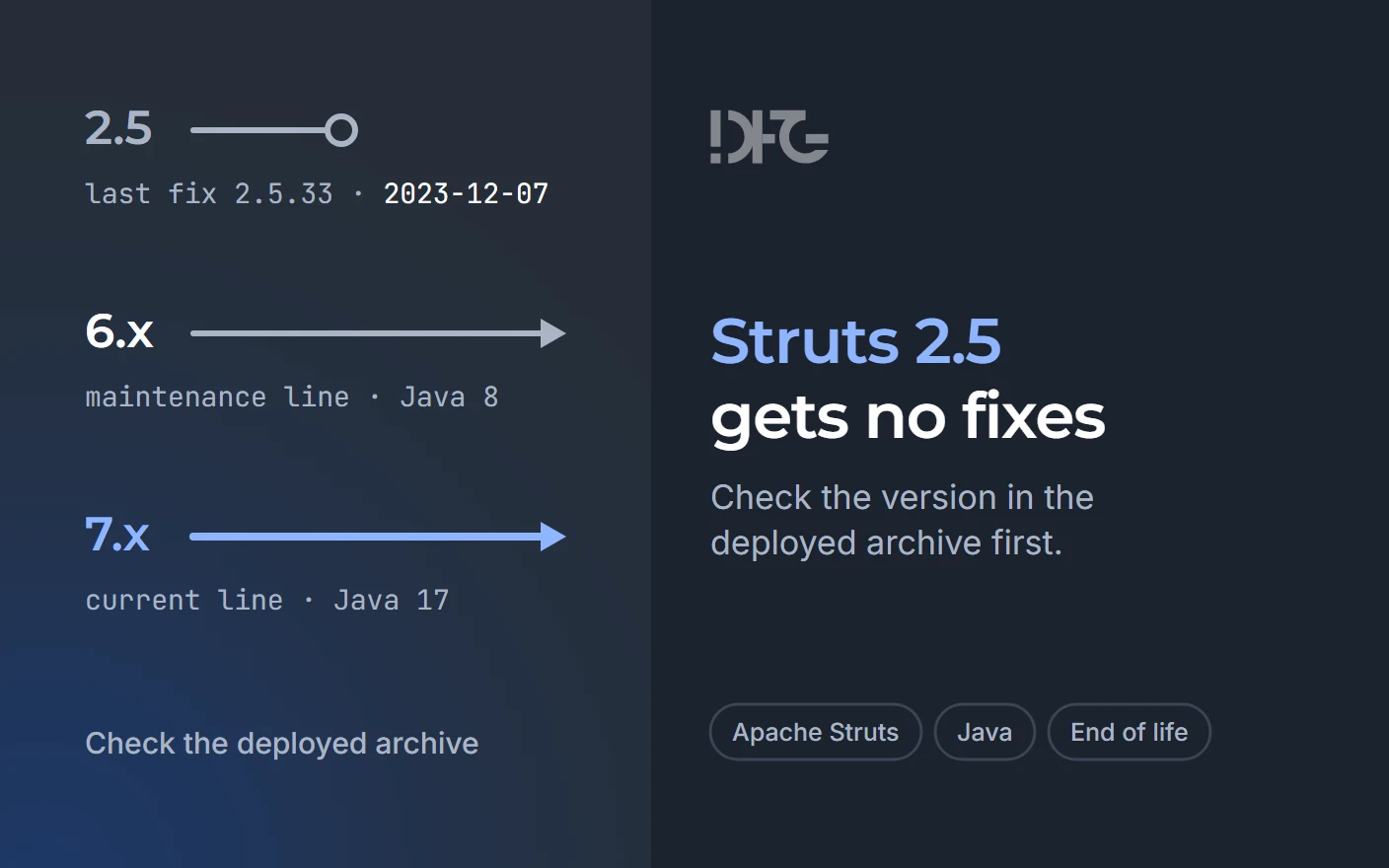
Define the blocker first: a completed blocker record turns a platform change into the smallest remaining decision. In the illustrative case, that decision is one library rebuild or replacement, proved by one workflow check. If the blocker is a Struts branch that gets no more fixes, check a Struts application before deciding; that is a separate question.
If one application is blocking a platform step, bring the component, version and workflow to discuss the next justified result.
Sources
- IBM: WebSphere Application Server - Support FYI
- IBM: WebSphere Application Server Traditional and WebSphere Liberty Support Lifecycle Policy and End of iFix Eligibility
- IBM: SSCD Software Support Lifecycle Policy: WebSphere Liberty
- IBM: Liberty product offerings for supported operating systems
- IBM: Get started with IBM AMA to modernize Java applications
- IBM: Get started with IBM AMA Dev Tools to modernize Java applications
- IBM: Configuring native libraries in shared libraries
- IBM: Demystifying Liberty for WebSphere admins
- IBM: Configuration differences between WebSphere Application Server traditional and Liberty: security
- IBM: WASPreUpgrade command
- Oracle: Java Native Interface Specification: Introduction
- Oracle: Java Native Interface Specification: Design Overview
Frequently asked questions
Does leaving WebSphere always require an application rewrite?
No. What changes decides it. A WebSphere traditional migration to another operating system keeps the same release and its classes, while a library built for AIX is rebuilt or replaced. A move to Liberty needs code changes where the application uses classes that Liberty lacks.
Is an announced WebSphere end-of-support date required to justify a platform decision?
The platform change belongs to the business, and this article takes it as given. IBM states no planned end-of-support date for WebSphere 8.5.5 and 9.0.5, and Liberty has no end-of-support announcements. Support for one server depends on its fix pack level.
Which dependencies can tie an application to WebSphere or AIX?
Seven classes: the exact runtime and fix pack level, proprietary IBM APIs, deployment configuration, security and identity, native libraries, admin and start scripts, and external connections. Each matters against the target, because some block a server change and others block an operating system change.
What can a migration tool establish about the application?
AMA inventories the application and flags WebSphere classes unavailable on Liberty, IBM JNDI values in code, shared code and external dependencies to verify during testing. Native libraries, scripts and JVM options are checked directly, by a run on the target.
How do we separate environment work from code changes?
Ask the questions in order. Does current support on a current fix pack meet the need? What changes: the server, the operating system or both? Does a dependency on that axis need changed code? If none does, the route is environment-only; otherwise, scope a bounded code change.
What if a shared library brings another application into scope?
Record it as another decision with its own owner, the unknown and the next check. The proof for one application stays inside its boundary. The shared library, the other application and any data migration each get a separate decision before work touches them.
What should a bounded change prove?
It should prove that the changed component builds from written instructions and that the named workflows pass under the agreed target conditions. The proof also lists the known differences from the old platform and the evidence status of each.
Does accepting the code change authorize a production migration?
No. Acceptance confirms the bounded code change against named workflows. The production migration is a separate decision. Production security settings, scripts and connections, the release plan, rollback and any data that moves each get their own owner and check.