In this article
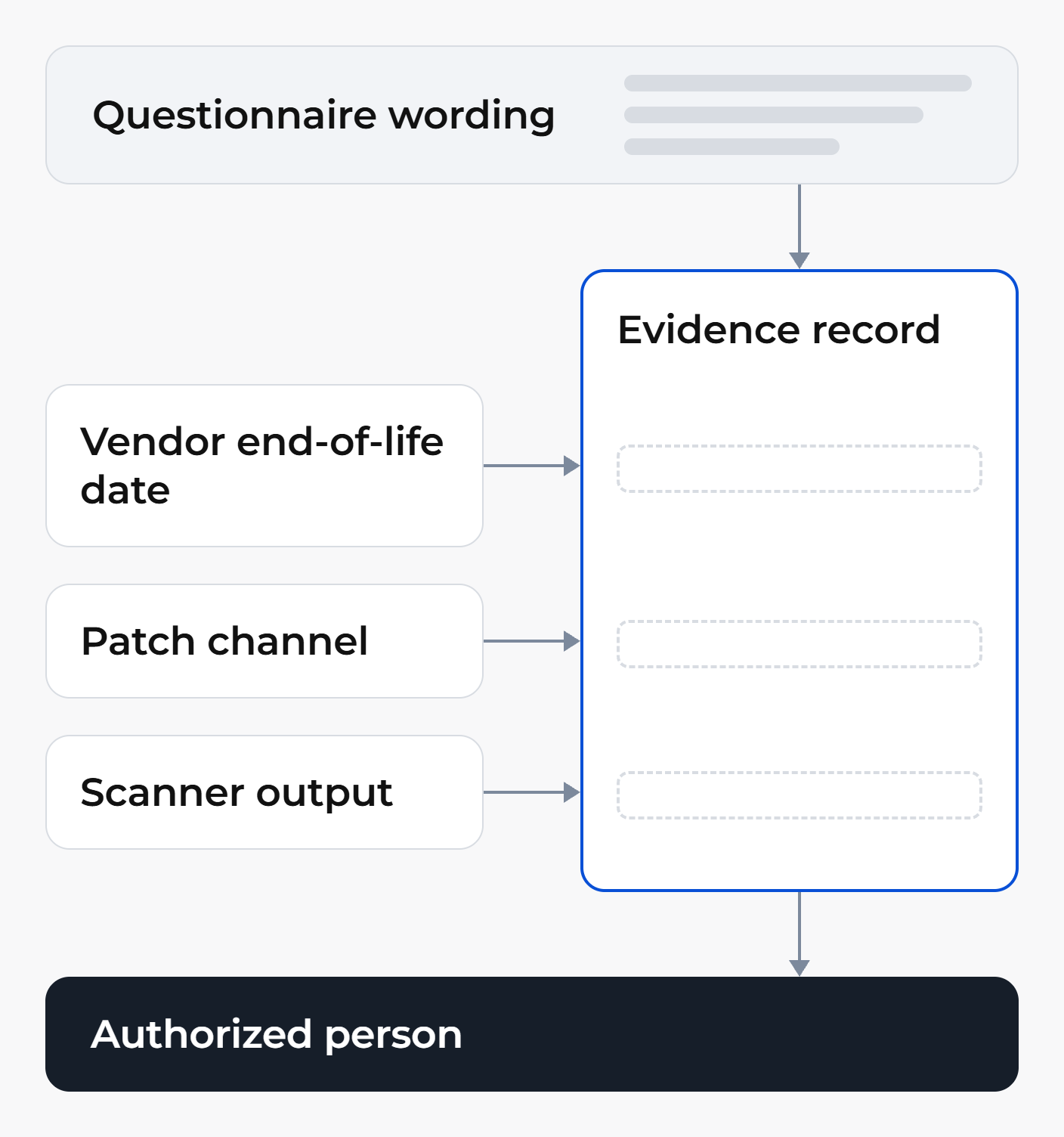
When a cyber insurance questionnaire asks about end-of-life software, the application owner prepares the technical evidence, and the authorized person chooses and signs the answer. The authorized person is the person your organization authorizes to sign the questionnaire. Start from the questionnaire you received, with its edition and exact item. Then record four facts separately: vendor end-of-life date, patch channel (where fixes for your build come from), scanner output and the exact questionnaire wording. Whether the item says end-of-life or unsupported software, the record goes to the authorized person.
Preserve the question, edition and scope
Copy the publisher, edition, item number and wording into the record: the three questionnaires below word the question differently. They are dated examples: at renewal, an insurer may send a different questionnaire or edition.
| Questionnaire and printed identifier | Item and excerpt | Also asks |
|---|---|---|
| Beazley, Cyber Insurance Application, F00657 042023 ed. | 18a: "Do you have any end-of-life or end-of-support software on your network?" Options include "Don't know". | 18b: "is the software segregated on your network?" |
| Chubb, Digitech® Enterprise Risk Management, Technology E&O, Cyber and Privacy Insurance Short Form Application, PF-48204 (10/16) | 4.c: the applicant uses no software or hardware "officially retired (i.e. considered "end of life") by the manufacturer" | Also covers "manufacturer required software updates": two conditions, one statement |
| CFC, Cyber large corporate US, copyright line 2019, file v22 | 6.4: "Do you use any software that is no longer supported by the manufacturer (e.g. Windows XP)?" | The number of devices and any "compensating controls" |
None of the three defines "end-of-life", "end-of-support", "officially retired" or "no longer supported". Beazley adds an "Additional Disclosures & Clarifications" section for incomplete answers.
Keep technical evidence and insurance decisions separate
The authorized person chooses the box, writes any clarification, decides whether to report a change and signs; the application owner supplies checkable facts. Beazley's signer declares being "AUTHORIZED BY THE APPLICANT". Chubb's signer, the "risk manager or a senior officer", declares the statements true and complete "after reasonable inquiry". CFC asks a "senior member of staff" to complete the questionnaire after checking with senior managers and colleagues.
None names the application owner. If a term is unclear, the broker is one place to ask.
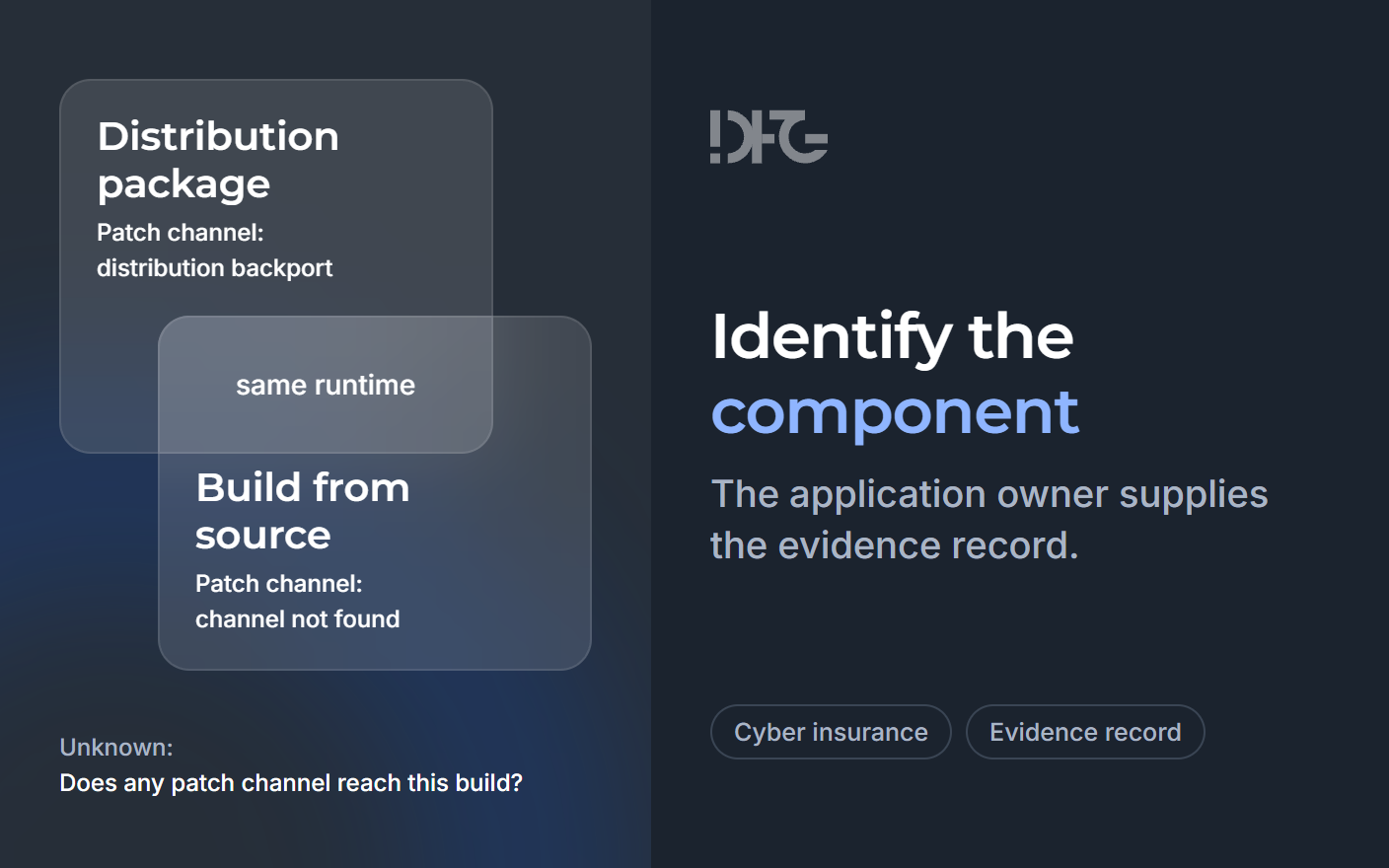
Identify the actual component and patch channel
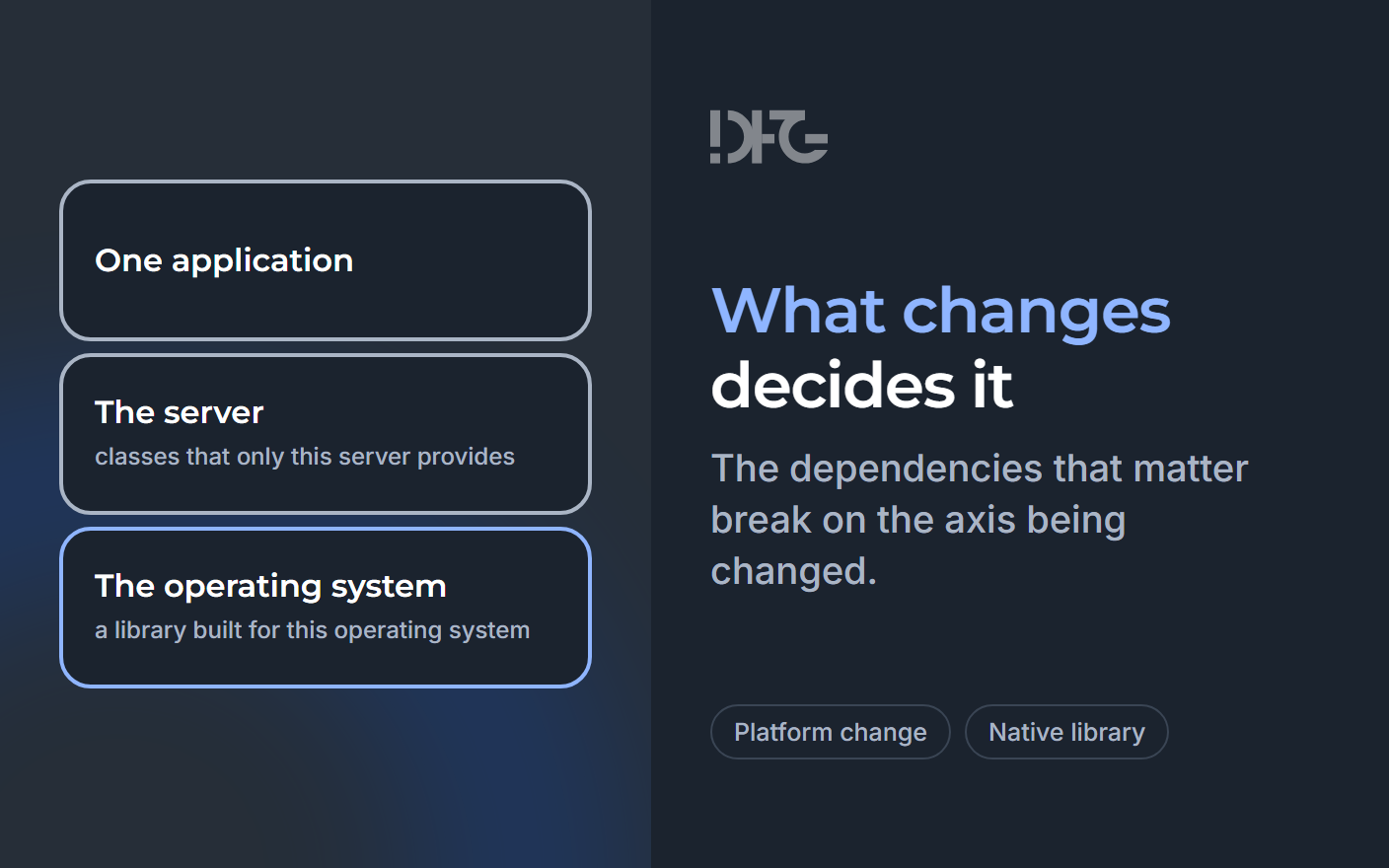
Identify the component by what runs on the host: installed version, build origin and the channel that delivers its fixes.
Each patch channel type has its own reach and dated proof of being enabled.
- Distribution backport: the installed package version matched against the security advisory, the check Debian describes.
- Vendor extended updates: for Microsoft ESU on Azure Arc, Enabled in the Azure portal and Active in
azcmagent show. - Commercial third-party support: for HeroDevs, the subscription and the alternate registry where it publishes patched versions of releases customers already run.
Record source and limits of support evidence
Give each fact its own source and date, because each publisher limits what its evidence shows.
- Vendor end-of-life date. Red Hat's Application Streams lifecycles "align to the upstream support life or to product needs as required". Red Hat's PHP stream and php.net branch dates differ in both directions; record both.
- Patch channel. Red Hat backports fixes and warns that "just looking at the version number of a package will not tell them if they are vulnerable or not". Microsoft says ESU "does not extend the product's lifecycle" and ships updates "if and when available". Canonical lists "A guarantee to fix all High or Critical CVEs" among what Ubuntu Pro ESM does not guarantee.
- Scanner output. Tenable plugin 58987 flags PHP "According to its version"; plugin 84574 warns of patches backported "without changing its version number". Whether plugin 58987 accounts for backports, its page does not say; record that as unknown.
A support subscription does not prove that an underwriter will accept a proposed answer.
Build an application evidence worksheet
Use one worksheet, a seven-field template, per application; each filled-in worksheet is an evidence record for the authorized person.
| Field | What to write |
|---|---|
| Exact question | Item number and wording copied with publisher and edition. Complete when anyone can find the same words. |
| Scope | Deployments covered and those left out. Complete when every deployment is in or out. |
| Component | Name, installed version, build origin, dependent workflow. Complete when the version was read on the host. |
| Support evidence | Vendor end-of-life date: project and distribution dates; source, as of YYYY-MM-DD Patch channel: type, proof it is enabled, planned or done, with date; source, as of YYYY-MM-DD Scanner output: tool, check, what the result rests on; source, as of YYYY-MM-DD |
| Unknown | Each unsettled fact, as a question. Complete when no other field hides one. |
| Responsible reviewer | Who confirms each line. Complete when every line has a name or role. |
| Clarification needed | Questions only the authorized person can settle. Complete when every unknown touching the wording is here. |
Some unsupported components stay in place on purpose. For them, CIS Controls Safeguard 2.2 asks teams to "document an exception detailing mitigating controls and residual risk acceptance". These documented exceptions belong to a security controls catalog and say nothing about insurance coverage.
Work through an illustrative evidence gap
Illustrative example: a fictional agent license status report runs on one scripting runtime installed two ways. One deployment gives a complete evidence record, the other a gap.
| Field | Entry |
|---|---|
| Exact question | As copied from the questionnaire received, with edition and item |
| Scope | Production hosts of the report; test hosts out |
| Component | Scripting runtime packaged by the operating system vendor; package version from the host |
| Support evidence | Vendor end-of-life date: project date and package stream retirement date, each from its lifecycle page; as of YYYY-MM-DD Patch channel: distribution backport; package version matched against the advisory; done, with date; as of YYYY-MM-DD Scanner output: version-based result, check name, scan date; as of YYYY-MM-DD |
| Unknown | Does the scanner check account for backported fixes? |
| Responsible reviewer | Platform owner for package lines; security owner for the scanner line |
| Clarification needed | How the questionnaire term applies to a runtime past its project date |
Here the distribution's fixes may be enough, and the record can say so. The build from source differs in these fields:
| Field | Entry |
|---|---|
| Component | The same runtime built from source; version read from the binary |
| Support evidence | Vendor end-of-life date: project date only; as of YYYY-MM-DD Patch channel: channel not found in the sources checked, as of YYYY-MM-DD; searched: distribution advisories, extended support subscriptions, third-party vendor records |
| Unknown | Does any patch channel reach this build? |
Red Hat and Debian describe backports for their own packages; this build is not one. Its patch channel line records a dated search and draws no conclusion beyond it.
Record unknowns and clarification owners
Each unknown gets a person who clarifies it and a next check.
| Unknown | Who clarifies | Next check |
|---|---|---|
| Scanner check and backported fixes | Security owner | Ask the scanner vendor and record the answer, with a date |
| Patch channel for the build from source | Platform owner | Repeat the search with a new date |
| How the questionnaire term applies | Authorized person | Decide, or ask the broker |
An unknown in the record is a working state, separate from a questionnaire's "Don't know" option. Moving from one to the other is the authorized person's decision.
Compare technical options without promising coverage
Each of the three technical options changes a named line and needs its own proof. None settles insurance coverage.
| Option | Line that changes | Proof |
|---|---|---|
| Sufficient patch channel | Patch channel | Installed package version matched against the advisory, the package stream's lifecycle row, or a dated extended support enrollment, such as Microsoft ESU |
| Environment change | Component, vendor end-of-life date and patch channel; or a separate isolation entry | A package with a channel, plus regression results; or segregation evidence for Beazley 18b and CFC 6.4 compensating controls, with the vendor end-of-life date unchanged |
| Code work | Component and vendor end-of-life date | The application on a supported branch of the component: build, test results, known differences |
Distinguish a plan from an implemented change
A plan and an implemented change differ by date and by what the host shows.
- Plan: ticket, owner and target date; the patch channel line says planned.
- Implemented change: the date it happened, status read on the host, test results; the line says done, with date.
The questionnaires ask in the present tense ("Do you use"). Beazley F00657 says responses "should be accurate as of the date that the application is signed and dated". The applicant also agrees to notify the insurer of changes before the insurance takes effect.
Record the evidence, owner and remaining uncertainty
After an option is done, update the changed lines, name who confirmed them and move open points to clarification needed. In the example, replacing the build from source with the distribution package turns its patch channel line into distribution backport, done, with date. The platform owner, as responsible reviewer, confirms it on the host. The scanner question stays open, and the record proposes no answer.
Prepare one application evidence record for review
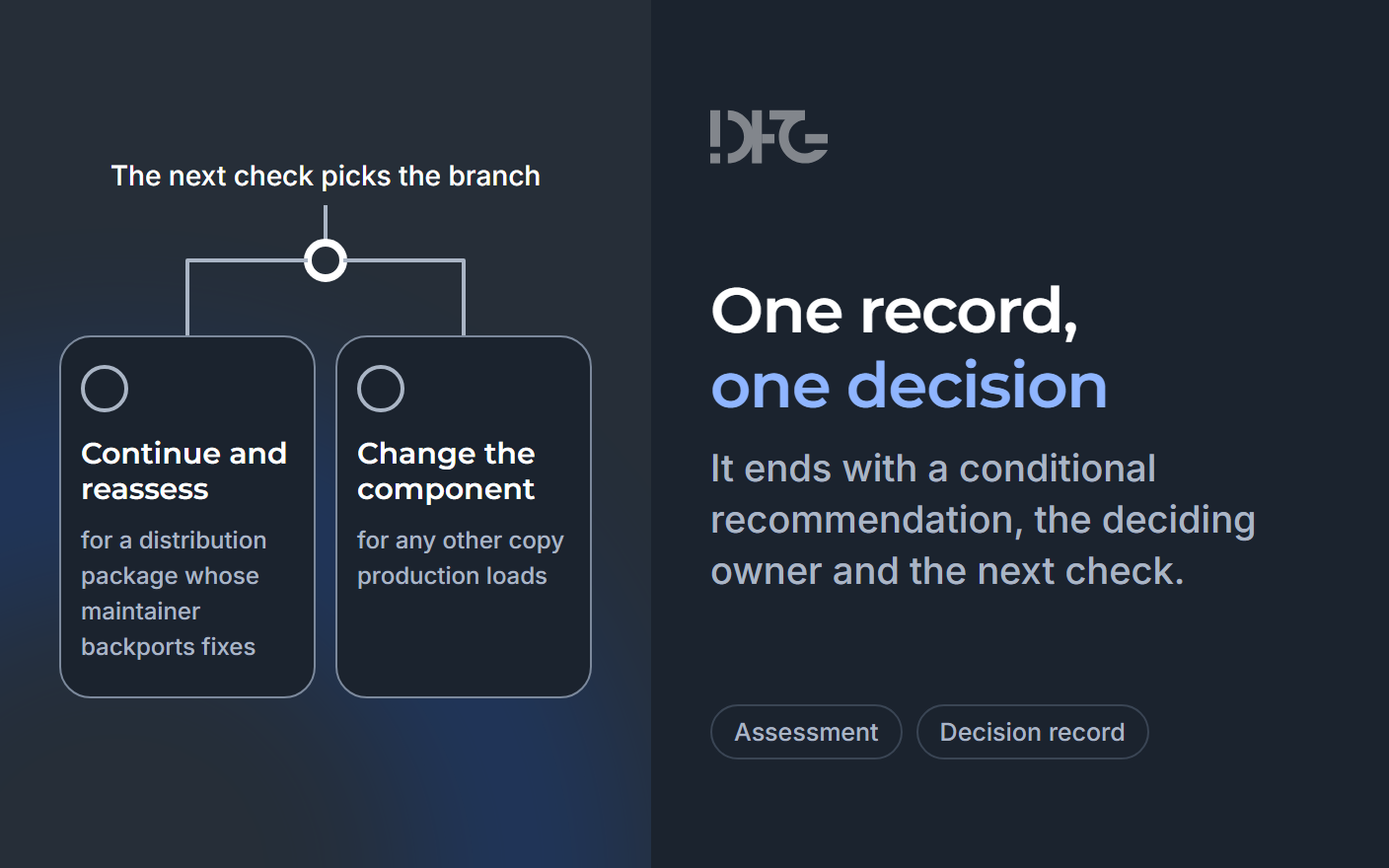
Review the evidence record in this order; the first failing step names the smallest decision still open.
- The exact question matches the questionnaire received.
- Every deployment in scope has a component line from the host.
- Each support evidence line has a source and an as-of date.
- Each unknown has a person who clarifies it and a next check.
- Clarification needed holds only questions for the authorized person.
When the record shows the question comes down to the component itself, a conversation about that one application makes sense.
If one application is blocking a platform step, bring the component, version and workflow to discuss the next justified result.
Sources
- Beazley: F00657
- Chubb: PF-48204
- CFC: Cyber large corporate US
- Red Hat: Backporting; Application Streams
- Debian: Security FAQ
- PHP: Supported Versions; Unsupported Branches
- Microsoft: ESU FAQ; ESU with Azure Arc
- Canonical: Ubuntu Pro description
- Tenable: Plugin 58987; Plugin 84574
- CIS: Control 2
- HeroDevs: Never-Ending Support
Frequently asked questions
What should an application owner check when a questionnaire asks about unsupported software?
Start with the exact questionnaire wording, its edition and item. Then check the component and version on each host, its build origin, patch channel, vendor end-of-life date and scanner output, each recorded with a source and date.
Is upstream end of life the same as having no patch channel?
Not always. Red Hat and Debian backport fixes into older versions of the packages they distribute. Red Hat aligns Application Streams lifecycles to upstream support or product needs. A build from source needs its own search.
What evidence can identify the actual support arrangement?
Evidence that names the channel and a date. For a distribution package, the installed version matched against the advisory. For Microsoft ESU on Azure Arc, the Enabled and Active statuses. For HeroDevs, the subscription and its registry.
Does extended support guarantee that an insurer will accept an answer?
Extended support is a patch channel. Microsoft says ESU does not extend the product's lifecycle and ships updates if and when available. The record notes the enrollment, its date and its reach; the answer stays with the authorized person.
What if the scanner result and vendor patch evidence disagree?
Record both, plus the disagreement as an unknown. Tenable plugin 58987 judges PHP by version; plugin 84574 warns of patches backported without a version change. Red Hat links false positives to tools that ignore its backports.
Who should decide how the organization answers the questionnaire?
The authorized person. Beazley F00657 has the signer declare authorization by the applicant; Chubb PF-48204 asks for the risk manager or a senior officer. CFC wants a senior member of staff to complete its questionnaire. The application owner supplies the evidence record.
Can a remediation plan be described as a completed change?
The record keeps them apart. A plan has a ticket, an owner and a target date; its line says planned. A completed change has a date and a state checked on the host. Beazley F00657 wants responses accurate when signed.
What information should be prepared before discussing an application blocker?
The evidence record for that application. It holds the component and exact version, build origin, the dated patch channel search, the scanner output, the dependent workflow and the open unknowns. The conversation then starts from checked facts.